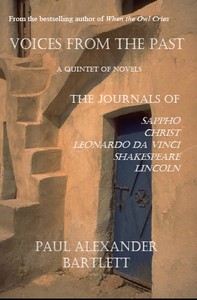
Voices from the Past — Edition Insights
Edition facts
For Voices from the Past — Edition Insights, the stored edition analysis reports 149,742 words, 10 hr 52 min estimated reading time, and 22 detected text sections.
The text analysis averages about 12.7 words per sentence, while the detected sections provide another way to judge how the source is divided.
Project Gutenberg metadata also associates the work with “Historical fiction,” connecting these edition facts with the source record’s subject description.
Calculated from edition completeness, EPUB availability, text structure and catalogue metadata. Not a user rating.
How this score is calculated
- Description quality20 pts
- Title & short description10 pts
- Source metadata20 pts
- Text length15 pts
- Chapters / structure15 pts
- EPUB file integrity20 pts
Total of 100 points, scaled to a 2.5-5.0 range. Editions with an empty description or a missing EPUB file are not scored.
Read the Text
sandals, I walked to the pier and the seagulls screamed and we waited and waited. People surged all about, saying wild things, shrieking—then, ominously, fell silent. Their shouts were better than their silence. The ocean seemed too calm, as if it had been smothered by the fog or dreaded the arrival of our fleet.
I had pictured the ships as fast moving, bright on bright water.
As the first one approached, I saw no happy faces, no lifted hands, no raised shields, no plumed helmets at the rail, no flags.
I heard an oar drag and in that sound I heard the rasp of death. If Alcaeus is dead, I will take poison—and I saw myself going to Xerxes, our Persian chemist, and asking for the powder. We had agreed, years back, during another crisis, that he would allow me this gift to free myself, if I must. His yellow face vanished, as I watched an anchor plunge slowly and saw the sail topple into the water and heard a man cry some name.
Voices caught our song, way out at sea, assuring us that these were not phantoms.
Ten years ago, almost ten—ten years ago, he had left Mytilene, the wars sweeping him away. Ten years we had lived with fear creeping about our island. Ten years—how my fingers trembled. I saw those years, there on the wharf, saw them in the gulls’ wings, in the distraught faces about me, my girls’, my friends’, my neighbors’. We had all waited for this homecoming. And now, now our fleet was gliding toward us, grey-hulked, no flags raised, oars shuffling like sick crabs.
Was it defeat or half-victory? Who, among our men, was lost, dead, or wounded? Gull on the masthead, apple at the end of the bough, what can you tell us at such crucial times? For an infinitude, the oars paced, a boat swung, another boat anchoring alongside, the armor on deck flashing, the waves gulping at the gulls.
I turned away, moved back.
And then I saw someone helping Alcaeus ashore—wounded or ill—and old, old, I thought.
Beauty said to me: This is only change.
And I said: But what is change?
And I slipped away, not daring to meet him, hoping someone would shout a name and confirm that this was another, not Alcaeus. But no, I knew. A woman knows a man she has loved, however battered he may be. I turned to watch his blundering progress.
The chorus had dwindled—only those at sea, the far off crews, still carried the hymn. I could not remain any longer. I hurried home, past his house to mine, wondering what kind of haven it could be, wondering what people would say at my flight. Yet this was not flight; it was merely a postponement, waiting for a sign, a chance to prepare myself. Alcaeus...must I send someone to him? What must I do? Go to his home? Shall I be there for him when he arrives?
At my door I turned and retraced my steps to his house, the laces of my sandals making a sound I had never heard before, the gulls wailing, the sounds from the wharf intermingling and incomprehensible.
And I was there when he came with his servant, an ugly Parthian, helping him. Yes, I was there and put out my hand to touch him, hearing his troubled breathing, seeing his torn and disheveled clothes, his rank beard, and knowing he was ill. I remembered the dream, the ship with its broken sail. And I remembered our love and I said to him:
“Alcaeus...it is I, Sappho...”
He squared his shoulders, his cloak slipping away. His arms went out to me, then dropped to his side.
His eyes had the marble core of nothingness in them.
Appalled, I could scarcely stand. O God, what is this that can happen to a man? Why has it happened? His arms in bandages, his eyes forever bandaged by the dark.
He heard my whisper and shuffled backwards, bumping his servant; he moved forward then and gripped me hard, twisting my flesh, his great muscles rising in his hands.
“Take me to my room... You haven’t forgotten the way, have you?”
I took his arm and the Parthian opened the door and servants bowed about us; yes, I took his arm and silently we climbed the stairs to his room, his clothes rough against me, his sea smell around me. We passed his library that held the books he had loved. We passed his mother’s room, where she had died. We passed where light fell around us, though no light entered his eyes.
“You are in your room,” I said.
“Beside your Egyptian chair.”
The excerpt from the Leonardo da Vinci novel reveals a diary entry dated Cloux, October 6, 1518, written in a voice that oscillates between precise observation and philosophical musing. The narrator notes rain splashing across leaded glass and sputtering on an autumn fire, then immediately shifts to a dictation session with Francesco, who objects to trivialities: “I think we should write down important things.” This tension between the mundane and the monumental runs through the passage, as Leonardo catalogues treatises on heat, vapors, and water while also recalling his master Verrocchio’s craftsmanship—a fire opal set in gold, a copper sphere hoisted atop a cathedral. The diary form allows Bartlett to layer memory, present action, and aphorism without linear narrative.
Diary Form and the Illusion of Intimacy
The excerpt uses a first-person diary structure that mimics private reflection, yet the entries are clearly shaped for a reader. The narrator addresses Francesco, mentions a cat’s disappearance, and notes “lamps need fixing,” creating a sense of daily life. However, the voice also delivers polished aphorisms: “Pleasure and pain are best shown as twins, back to back, since they are inseparable.” This blend of casual detail and epigram suggests a crafted intimacy rather than raw transcription. The diary form allows Bartlett to jump between topics—Verrocchio’s workshop, the king’s visit, a singer’s exile—without transitional logic, mirroring the associative quality of memory.
Recurring Motifs: Fire, Cold, and the Passage of Time
The excerpt is punctuated by references to temperature and light. The entry opens with “cold, cold! Windy” and later notes “rain splashes across leaded glass and sputters on my autumn fire.” Fire appears again in the memory of Verrocchio’s fire opal “resembling a setting sun.” The copper sphere “unharmed by lightning” contrasts with the fragile human body. Time is measured in seasons—“my second autumn at the château”—and in the repeated phrase “Di me se mai fu fatta alcuna cosa” (Is anything ever done!), which appears scattered among papers. These motifs unify the fragmentary diary entries, giving them a melancholic coherence.
The Role of Francesco and the Workshop Dynamic
Francesco, presumably Francesco Melzi, Leonardo’s pupil and companion, serves as both audience and foil. He objects to trivialities, prompting Leonardo to “discriminate” among his hundred treatises. The dynamic recalls Leonardo’s own apprenticeship with Verrocchio: “I was twenty, like you, Francesco. And I was always hungry—like you.” The excerpt emphasizes the transmission of craft—Verrocchio’s skill with jewelry, his bronze horse, his putto—and the emotional weight of memory. The workshop is a place of “magic...subtleties in metal and wood,” but also of loss: “Andrea dead at fifty-three!” Francesco’s presence anchors the narrative, providing a listener for Leonardo’s recollections.
Readers approaching Voices from the Past should note that the excerpt represents only one of five novels, each with its own narrative voice and historical setting. The diary form may vary across the other sections; the catalog subjects include Sappho, Jesus, Shakespeare, and Lincoln, none of whom appear in this passage. The editorial note is based solely on the Leonardo excerpt, and the other novels may employ different structural or stylistic choices. The work rewards attention to recurring imagery and the interplay between private thought and public persona.
Leonardo’s diary entries about cold and fire reminded me of sitting by a window years ago, rereading A Tale of Two Cities — A Closer Reading. That book’s quiet sense of time folding over itself felt the same way—like watching shadows lengthen on a familiar wall. Both leave me holding a breath I didn’t know I’d been keeping.
Noah Davis
1 week agoSofia Thomas
3 weeks agoOwen Harris
1 month ago-
Derek Maldonado - 1 month ago
A hauntingly beautiful collection that resonates with modern readers. Each story in 'Voices From The Past' is crafted with exquisite detail and emotional depth. The author's ability to evoke time and place is remarkable, making history feel immediate and personal. A masterpiece of historical fiction. -
Michelle Davis - 2 weeks ago
A solid anthology of historical pieces with diverse settings and characters. Some stories shine more than others, but overall it's a pleasant read for history buffs. The inclusion of lesser-known perspectives is refreshing, though a few narratives feel underdeveloped. -
Gabriel Chambers - 1 week ago
Despite the intriguing concept, 'Voices From The Past' fails to deliver consistent quality. Many stories lack narrative tension, and the dialogue feels stilted. The author often tells rather than shows, leaving the reader disconnected. Disappointing for those expecting immersive historical fiction.
Your personal reading reflection
Build a private reading journal entry for this title.
Isaac Green
3 weeks ago