1

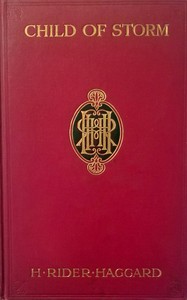
Child of Storm — Text and Context
(0 User reviews)
2545
Project Gutenberg
1999
Not confirmed
Historical fiction; Zulu (African people) -- Fiction; Quatermain, Allan (Fictitious character) -- Fiction; Zululand (South Africa) -- History -- Fiction
Readers of public-domain and historical texts
Project Gutenberg digital edition
en
Edition facts
Words
98,837
Reading time
430 min
Text sections
19
Child of Storm — Text and Context can be approached with a clearer sense of reading commitment from its source measurements: 98,837 words, 7 hr 10 min estimated reading time, and 19 detected text sections.
The text analysis averages about 21.9 words per sentence, while the detected sections provide another way to judge how the source is divided.
Project Gutenberg metadata also associates the work with “Historical fiction,” connecting these edition facts with the source record’s subject description.
Source:
Project Gutenberg record #1711
H. Rider Haggard's 'Child of Storm' follows Allan Quatermain in Zululand, where the enigmatic Mameena manipulates men and fate. The narrative blends adventure with Zulu customs, dialogue revealing character, and a looming sense of doom tied to the witch-doctor Zikali.
Editorial Edition Score
4.8/5
★★★★★
★★★★★
Calculated from edition completeness, EPUB availability, text structure and catalogue metadata. Not a user rating.
How this score is calculated
- Description quality20 pts
- Title & short description10 pts
- Source metadata20 pts
- Text length15 pts
- Chapters / structure15 pts
- EPUB file integrity20 pts
Total of 100 points, scaled to a 2.5-5.0 range. Editions with an empty description or a missing EPUB file are not scored.
Edition quality
Public-domain source text
Read the source text
The source text is kept in the dedicated reader, separate from this catalogue record and its commentary.
H. Rider Haggard's Child of Storm opens with a dedication that frames the novel as the second book in an 'epic of the vengeance of Zikali' and the fall of the House of Senzangakona. The author insists on the 'true Zulu spirit' of his tale, drawing on his own observations in the 1870s and the expertise of colonial officials like Theophilus Shepstone. This framing immediately establishes a tension between ethnographic authenticity and adventure fiction, a tension that plays out in the novel's detailed descriptions of Zulu customs and its melodramatic plot.
Diction and the Voice of Macumazahn
Allan Quatermain, known as Macumazahn, narrates in a colloquial, self-deprecating tone that contrasts with the high drama around him. His voice is marked by understatement and a wry awareness of his own limitations. When Mameena teases him for being slow-witted, he admits to 'turning red as the sky behind me.' This personal, almost confiding style draws the reader close, even as the events he describes grow increasingly violent and supernatural. Haggard uses Quatermain's plain speech to ground the exotic setting, making the fantastic seem credible.
Mameena's Dialogue: Manipulation and Vulnerability
Mameena's speech is a study in calculated ambiguity. She shifts between innocence and menace, often in the same sentence. When Quatermain asks why she married a man she hates, she replies with a metaphor: 'When one has only two thorn bushes to sit on... one chooses that which seems to have the fewest prickles.' Her dialogue is laced with double meanings and emotional volatility—she weeps 'really weeping this time' after earlier making her eyes swim. Haggard uses her words to create a character who is both predator and victim, her language a weapon she wields with precision.
Structure and the Sense of Foreboding
The novel's structure is built around a series of encounters that advance a sense of inevitable catastrophe. The dedication itself promises a 'third and final act' yet to come, and the narrative is punctuated by prophecies and warnings. Zikali, the 'Thing-that-should-never-have-been-born,' looms over the action, his words hinting at doom. Mameena's own speech is full of foreshadowing: she speaks of her herd of cows coming to 'a bad end,' and of being 'torn out of the reeds' that way. This layering of premonition gives the plot a tragic momentum, even when the immediate events seem driven by personal intrigue.
Setting and the Weight of Custom
Haggard's Zululand is a world governed by rigid social codes and supernatural beliefs. The landscape is described in terms of its practical and symbolic significance: the 'hooded kaross,' the 'wagon and the two horses,' the 'rise behind us.' Characters move through a terrain that is both physical and moral, where every action has consequences dictated by tradition. The author's note emphasizes that the Zulus, in their 'superstitious madness and bloodstained grandeur,' were not 'mean or vulgar.' This attempt to dignify the culture infuses the setting with a weight that elevates the personal dramas to something like epic tragedy.
The Role of Zikali
Zikali, the witch-doctor, is a shadowy figure whose influence pervades the narrative. He is described as 'the Little Wise One' and his counsel is sought by Mameena. His advice—to 'sit still and drink my sour milk' or to run away—is cryptic and self-serving. Haggard uses Zikali to embody the fatalism of the Zulu worldview, where spirits and curses shape destiny. Though he appears only indirectly in the excerpts, his presence is felt as a source of both wisdom and danger, a reminder that the characters are pawns in a larger, darker game.
Readers approaching Child of Storm should attend to the way Haggard balances adventure with cultural observation. The novel rewards attention to its dialogue, where character and fate are revealed through word choice and rhythm. Quatermain's narration provides a steady hand, but the real interest lies in the voices of the Zulu characters, especially Mameena, whose every line is a performance. The book is best read as a drama of language and power, set against a backdrop of colonial anxiety and Zulu resilience.
That rainy afternoon, Child of Storm left me with Mameena’s quiet scheming still humming, the weight of Zulu fate pressing like humid air. Later, almost without deciding, my hand drifted to The doom trail — Story, Setting & Ideas, and I found myself walking that same dusty, doomed landscape again, another set of footprints.
There are no reviews for this eBook.
There are no comments for this eBook.
Reader reflection
What did you think of this book?
Answer a few questions and save a private reflection on this device.
Your progress
0
/
10
2
What was your overall reaction to the book?
3
How likely are you to recommend this book?
4
What was the reading difficulty like?
5
How distinctive were its ideas or approach?
6
How personally connected did you feel to the book?
7
Did you gain anything practical from the text?
8
Could you follow the author’s main argument?
9
What is the main idea you are taking away?
10