1

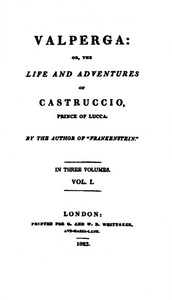
Valperga Volume 1 (of 3) or, The life and adventures of Castruccio, prince of Lucca — Themes and Context
(0 User reviews)
1052
Project Gutenberg
2020
Not confirmed
Historical fiction; Castracani, Castruccio, 1281-1328 -- Fiction; Guelfs and Ghibellines -- History -- Fiction; Condottieri -- Fiction; Italy -- History -- 1268-1492 -- Fiction; Lucca (Italy) -- History -- Fiction
Readers of public-domain and historical texts
Project Gutenberg digital edition
en
Edition facts
Words
57,971
Reading time
253 min
Text sections
5
Before opening Valperga Volume 1 (of 3) or, The life and adventures of Castruccio, prince of Lucca — Themes and Context, the edition data offers a quick orientation: 57,971 words, 4 hr 13 min estimated reading time, and 5 detected text sections.
The text analysis averages about 32.3 words per sentence, while the detected sections provide another way to judge how the source is divided.
Project Gutenberg metadata also associates the work with “Historical fiction,” connecting these edition facts with the source record’s subject description.
Source:
Project Gutenberg record #63337
Mary Shelley's 1823 historical novel follows Castruccio Castracani's rise amid Guelph-Ghibelline conflicts, using shifting dialogue and descriptive contrasts to reveal character and political maneuvering in 14th-century Italy.
Editorial Edition Score
4.7/5
★★★★★
★★★★★
Calculated from edition completeness, EPUB availability, text structure and catalogue metadata. Not a user rating.
How this score is calculated
- Description quality20 pts
- Title & short description10 pts
- Source metadata20 pts
- Text length15 pts
- Chapters / structure15 pts
- EPUB file integrity20 pts
Total of 100 points, scaled to a 2.5-5.0 range. Editions with an empty description or a missing EPUB file are not scored.
Edition quality
Public-domain source text
Read the source text
The source text is kept in the dedicated reader, separate from this catalogue record and its commentary.
Mary Shelley's Valperga opens with a preface that explicitly distances itself from Machiavelli's 'romance' of Castruccio, grounding the narrative in Sismondi, Tegrino, and Villani. The first chapter immediately establishes a pattern of contrast: Italy is described as a land where 'the light of civilization had never been wholly extinguished,' yet the action begins with exile and military occupation. Shelley's prose shifts between panoramic historical summary and tightly focused dialogue, as when Castruccio questions Benedetto Pepi about his losses. Pepi's evasive, self-pitying replies—'I am always poor, always unfortunate'—are undercut by his earlier 'triumph and vanity,' revealing a character who performs destitution while hoarding influence. This early scene sets the novel's method: political maneuvering is exposed through verbal sparring and physical detail, not authorial commentary.
Diction and the Performance of Poverty
In the exchange between Castruccio and Benedetto Pepi, Shelley uses diction to dramatize the gap between appearance and reality. Pepi's initial answers are 'vivacious,' his 'brows elevated, a smile lurked in the corners of his strait lips.' When Castruccio calls him 'Benedetto the Rich,' his face falls, his 'arms sunk close to his sides.' The physical vocabulary—'strait lips,' 'drawn down' mouth—maps emotion onto the body. Pepi's protestations of poverty rely on concrete nouns: 'stones,' 'plaster,' 'fifty small acres.' Yet his earlier rubbing of hands betrays satisfaction. Shelley does not label him a hypocrite; she lets the reader watch the performance shift. The repetition of 'poor' and 'unfortunate' becomes a verbal tic, a shield. This scene, drawn from the excerpts, shows how Shelley builds political opacity through lexical precision: Pepi's wealth is never confirmed, only implied by his own denials.
Dialogue as a Tool of Indirection
Shelley's dialogue rarely delivers straightforward information. When Castruccio asks Pepi about his plans, Pepi replies, 'Events are now my masters; soon I hope to rule them.' The aphoristic form conceals rather than reveals. Later, Pepi speaks 'half to himself,' saying 'this is not the time; events are as yet unripe.' The hesitation and self-interruption mimic real speech while advancing a plot of concealed intentions. Castruccio's own lines are direct but yield no answers: 'I shall be guided by accident.' The conversation ends with Pepi's promise of future revelation—'if Benedetto of Cremona be not exactly what he seems'—but no disclosure occurs. This pattern of deferred meaning recurs throughout the excerpts. Shelley uses dialogue not to clarify but to thicken mystery, forcing the reader to attend to tone, gesture, and what is left unsaid.
Descriptive Contrasts and Historical Setting
The novel's descriptive passages juxtapose ruin and resilience. The German soldiers have 'wasted' Pepi's palace, but he notes 'the walls are too thick to be hurt.' The physical solidity of stone contrasts with the fragility of political order. Castruccio's observation that 'many are fallen' is met with Pepi's muttered 'not so low—not so low.' Shelley embeds historical context—the Guelph-Ghibelline wars, the depredations of imperial troops—within personal exchanges. The setting is not merely backdrop; it is a force that shapes speech. When Castruccio speaks of 'unhappy orphans,' Pepi responds with calculation: 'the dead have heirs.' The moral weight of the historical moment is carried by such small verbal collisions. Shelley avoids lengthy exposition, instead letting the physical and social landscape emerge through the characters' preoccupations with loss, survival, and advantage.
Voice and the Unreliable Narrator
Though the novel employs a third-person narrator, the excerpts reveal a voice that shifts between omniscient summary and close psychological observation. The narrator reports Pepi's 'expression of triumph and vanity, which he in vain strove to conceal,' then immediately shows him failing to conceal it. The narrative voice is analytical, almost clinical, in its attention to facial cues and tonal shifts. Yet it also withholds judgment: Pepi's motives remain opaque. The preface's claim to historical accuracy—citing Sismondi and Villani—suggests a narrator who values fact, but the dialogue scenes are patently constructed. This tension between documentary ambition and novelistic invention defines the authorial stance. Shelley does not claim to reproduce history; she uses historical figures to explore how power is negotiated through language. The reader is left to weigh the evidence of speech against the evidence of gesture, much as a historian might weigh conflicting sources.
Readers attentive to Shelley's craft will find that Valperga rewards close attention to its verbal surfaces. The novel's political drama unfolds less in battles than in the pauses between sentences, the flicker of a smile, the repetition of a word. Treat each conversation as a scene of negotiation, and each descriptive detail as a clue to character. The incomplete excerpts leave the full arc of Castruccio's career unknown, but the patterns established here—indirection, physicality, historical density—are likely to persist. Approach the text as a study in how people use language to claim, hide, and project power.
Reading Valperga, I keep thinking how Shelley paints political ambition as a tide that reshapes ordinary lives. That ache carries me to The Prince of India; Or, Why Constantinople Fell — Volume 01 — Text and Context, where another city waits under a different shadow, and the same quiet weight of history presses down. Strange, how two distant worlds can share that single, patient sorrow.
There are no reviews for this eBook.
There are no comments for this eBook.
Reader reflection
Your personal reading reflection
Build a private reading journal entry for this title.
Your progress
0
/
10
2
Did this book hold your interest?
3
Would you encourage someone else to read it?
4
How much effort did this book require?
5
Would you read this book again?
6
How original did the book feel?
7
Would this book work well in a reading group?
8
How closely did the book connect with your experience?
9
Which lesson or insight stayed with you?
10