1

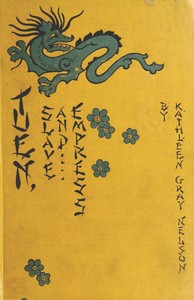
Tuen, Slave and Empress — Text and Context
(0 User reviews)
1273
Project Gutenberg
2018
Not confirmed
Historical fiction; Biographical fiction; Cixi, Empress dowager of China, 1835-1908 -- Fiction; Empresses -- Fiction; China -- History -- 19th century -- Fiction
Readers of public-domain and historical texts
Project Gutenberg digital edition
en
Edition facts
Words
31,738
Reading time
138 min
Text sections
4
For Tuen, Slave and Empress — Text and Context, the stored edition analysis reports 31,738 words, 2 hr 18 min estimated reading time, and 4 detected text sections.
The text analysis averages about 23.7 words per sentence, while the detected sections provide another way to judge how the source is divided.
Project Gutenberg metadata also associates the work with “Historical fiction,” connecting these edition facts with the source record’s subject description.
Source:
Project Gutenberg record #58369
An 1898 biographical novel tracing Tuen's rise from slave to empress dowager of China, based on the life of Cixi. The narrative employs ornate period diction, detailed court rituals, and a third-person voice that shifts between intimate observation and formal chronicle.
Editorial Edition Score
4.6/5
★★★★★
★★★★★
Calculated from edition completeness, EPUB availability, text structure and catalogue metadata. Not a user rating.
How this score is calculated
- Description quality20 pts
- Title & short description10 pts
- Source metadata20 pts
- Text length15 pts
- Chapters / structure15 pts
- EPUB file integrity20 pts
Total of 100 points, scaled to a 2.5-5.0 range. Editions with an empty description or a missing EPUB file are not scored.
Edition quality
Public-domain source text
Read the source text
The source text is kept in the dedicated reader, separate from this catalogue record and its commentary.
The novel opens with a deliberate inversion of the natural order: 'The sun had set in the land where the dragon reigns, and darkness and silence and rest and sleep, the ministers of the night, waited to come to their own. But their presence was not needed.' This personification of night's ministers immediately establishes a world where even elemental forces are subordinate to imperial will. The prose is stately, almost ceremonial, matching the hierarchical society it depicts. Nelson's diction leans toward the ornate—'obsequious servants,' 'august and jealous ruler'—yet she grounds the narrative in concrete sensory details: the 'gilt cup shaped like a Grecian urn,' the 'silver-tipped ivory chopsticks.' The opening chapter's theatrical performance within the story—a play about a wife demanded as tribute—foreshadows Tuen's own trajectory as a woman whose value is determined by male authority, though the excerpts do not reveal how this parallel resolves.
The Viceroy's Dilemma and the Gift Economy
The narrative's early tension revolves around the Viceroy's search for a gift worthy of the Emperor. This is not mere plot device; it reveals a world where every imperial favor demands a reciprocal offering, and where human beings can be considered among the 'richest wares.' The Viceroy 'sought for some costly gift to lay at the feet of that august and jealous ruler who calls himself the Son of Heaven.' The phrasing emphasizes the Emperor's divine pretensions and the precariousness of favor. Nelson details the feast preparations with ethnographic precision: 'crimson tickets' requesting 'the illumination of their presence,' the sequence of dishes from 'salted relishes' to 'bird-nest soup' to 'shark-fins.' This accumulation of ritual detail serves to normalize the Viceroy's eventual decision to present Tuen as a gift—a choice the excerpts do not depict but the preface announces. The authorial choice to embed this transaction within lavish description makes the commodification of a young woman seem almost inevitable within the story's logic.
Diction of Hierarchy and Restraint
Nelson's vocabulary consistently reinforces social rank. Characters are identified by titles—'the Viceroy,' 'the governor-general,' 'the Son of Heaven'—rather than personal names in the opening chapters. Even the slave girl is referred to as 'Tuen' without familial designation. The prose employs formal constructions: 'bestow the illumination of their presence,' 'the subject is expected to send some valuable present.' This language mirrors the elaborate courtesy of Chinese court protocol while also signaling the emotional distance between characters. When the Viceroy considers Tuen's marriage, he murmurs that 'only the son of a mandarin shall have her in marriage,' using indirect speech that keeps his interiority at arm's length. The narrator rarely enters a character's mind; instead, actions and spoken words carry the burden of motivation. This restraint creates a sense of inscrutability that aligns with Western perceptions of Chinese culture at the time of writing, but it also leaves readers to infer the emotional cost of these transactions.
The Play Within the Story as Structural Mirror
Chapter I includes a full theatrical performance that parallels Tuen's situation. The play recounts 'a beautiful wife of a former Emperor, who was demanded as a tribute by the Tartar Khan.' The Emperor 'is in despair, for his country is weak and not prepared to go to war,' and he 'is forced to yield.' The guests watch while eating, 'nodding approvingly' as the Princess tragically asks, 'What place is this?' on her way to the Khan. Nelson does not comment on the irony, but the juxtaposition is deliberate: a woman given as tribute to prevent war, while in the framing story a woman is being groomed as a gift to secure favor. The play's tragic tone—'the music sinks to a low, reverberating wail'—contrasts with the guests' complacent enjoyment. This embedded narrative device allows Nelson to critique the treatment of women without direct authorial intervention. The excerpts do not reveal whether Tuen herself ever sees or reflects on this performance, but the structural echo suggests a pattern of female sacrifice that the novel may explore further.
Voice and the Limits of Historical Fiction
The preface explicitly states that the story 'is founded upon facts in the life of the Empress-dowager of China,' yet the narrative voice oscillates between omniscient chronicler and limited observer. Descriptions of setting are panoramic—'the barren landscape,' 'the patient buffalo'—while character interactions are rendered through external detail: the Viceroy 'would sigh to think that even now it was time to betroth her.' The narrator knows the Viceroy's thoughts but reports them as indirect murmurings, maintaining a formal distance. This hybrid voice reflects the challenges of writing historical fiction about a living figure (the Empress-dowager was still alive when the novel was published in 1898). Nelson cannot invent interiority freely, so she relies on gesture and reported speech. The result is a text that feels both intimate and withheld. Readers should attend to what is left unsaid—the gaps between the Viceroy's political calculations and Tuen's probable experience—as a deliberate authorial choice that invites inference without confirmation.
This edition preserves the original 1898 text with its period-specific prose and cultural assumptions. Readers interested in late-Victorian representations of China will find the novel a revealing document of its era. The author's reliance on external description rather than psychological depth means that Tuen's inner life remains largely inferred; the narrative rewards attention to what characters do and say rather than what they think. The preface and opening chapters establish a world where women are objects of exchange, but the excerpts do not reveal whether Tuen ever gains agency. Approach the text as a historical artifact that tells us as much about 1890s American authorship as about nineteenth-century China.
That rain pressed against the windows while Tuen’s gilded cages gleamed on the page, her power built on silks and whispered executions. Afterwards, I found myself reaching for another kind of tyranny, colder and louder, in The White Terror and The Red: A Novel of Revolutionary Russia — Background and Themes. Both worlds trade in fear, yet the rain never stopped falling. I simply turned the page.
There are no reviews for this eBook.
There are no comments for this eBook.
Reader reflection
How did this book work for you?
Your answers remain private and are stored only in this browser.
Your progress
0
/
10
2
Did this book hold your interest?
3
Is this a title you would suggest to others?
4
How easy was the book to follow?
5
Was the book what you thought it would be?
6
Could you apply anything you learned?
7
How strongly did the book affect you emotionally?
8
How original did the book feel?
9
Which lesson or insight stayed with you?
10