1

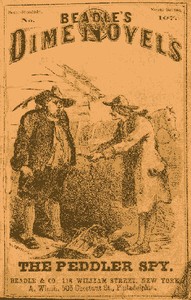
The Peddler Spy; or, Dutchmen and Yankees. A Tale of the Capture of Good Hope — Text and Context
(0 User reviews)
967
Project Gutenberg
2017
Not confirmed
Historical fiction; Adventure stories; United States -- History -- Colonial period, ca. 1600-1775 -- Fiction; Dime novels
Readers of public-domain and historical texts
Project Gutenberg digital edition
en
Edition facts
Words
37,014
Reading time
161 min
Text sections
4
The source record for The Peddler Spy; or, Dutchmen and Yankees. A Tale of the Capture of Good Hope — Text and Context measures this digital text at 37,014 words, 2 hr 41 min estimated reading time, and 4 detected text sections.
The text analysis averages about 12.8 words per sentence, while the detected sections provide another way to judge how the source is divided.
Project Gutenberg metadata also associates the work with “Historical fiction,” connecting these edition facts with the source record’s subject description.
Source:
Project Gutenberg record #55772
A dime novel from 1866 set in colonial Connecticut, where a Yankee peddler outwits Dutch settlers at Fort Good Hope. The excerpts reveal a comic tone, broken English dialogue, and a horse-swapping trick, but the spy plot remains largely offstage.
Editorial Edition Score
4.5/5
★★★★★
★★★★★
Calculated from edition completeness, EPUB availability, text structure and catalogue metadata. Not a user rating.
How this score is calculated
- Description quality20 pts
- Title & short description10 pts
- Source metadata20 pts
- Text length15 pts
- Chapters / structure15 pts
- EPUB file integrity20 pts
Total of 100 points, scaled to a 2.5-5.0 range. Editions with an empty description or a missing EPUB file are not scored.
Edition quality
Public-domain source text
Read the source text
The source text is kept in the dedicated reader, separate from this catalogue record and its commentary.
W. J. Hamilton’s 1866 dime novel opens with a wink at Washington Irving, citing “Knickerbocker’s History of New York” as a “veracious chronicle” while immediately undercutting its reliability. The narrator aligns himself with the Yankee side, calling the Dutch “stolid” and ill-suited to a contest of wits. The first chapter’s subtitle, “Boston ‘Dickers’ with the Dutchmen,” signals that the central action will be a series of trades and deceptions rather than pitched battles.
The catalog subjects list “Historical fiction” and “Adventure stories,” but the surviving text dwells less on military adventure than on comic ethnic stereotypes and verbal sparring. The excerpts show no spy activity, no capture of the fort, and no sustained action—only a horse-swapping trick that leaves a Dutchman humiliated. Readers expecting a straightforward tale of espionage may find the actual emphasis on dialect comedy and petty swindles instead.
Comic Dutch Dialect and Character Types
Hamilton renders Dutch speech in a thick, broken English that serves both as humor and as a marker of national character. Ten Eyck, for instance, shifts into “broken English” when discussing a horse purchase: “I sells him den. I puys him … vor fear Paul Swedlepipe get him.” The narrator repeatedly calls the Dutchmen “stolid” and contrasts them with the quick-witted Yankees. The comedy relies on the reader’s familiarity with stage-Dutch conventions—the slow, literal-minded burgher who is easily duped.
Ten Eyck’s vanity is drawn in broad strokes: he “seemed to grow taller” when approaching his horse, only to find the animal transformed overnight into a toothless, tail-less wreck. The narrator invokes the ballad “Lord Bateman” to compare Ten Eyck’s strutting posture, a reference that would have been familiar to contemporary readers. The Dutch are not villains but butts; the real conflict is between Yankee ingenuity and Dutch gullibility.
The Horse-Swapping Trick as Narrative Center
The most fully rendered scene in the excerpts is a horse trade that goes spectacularly wrong for the Dutchman Ten Eyck. He buys a horse from a Yankee peddler (presumably the “peddler spy” of the title) for 150 guilders, only to discover the next morning that the animal has lost its tail and teeth, and its hide is streaked with dye. The trick is orchestrated with the help of Paul Swedlepipe, a rival Dutchman, suggesting that internal Dutch rivalries are as important as Yankee cunning.
The scene is described with elaborate physical comedy: Ten Eyck’s inflated pride, the careful removal of corral bars, and the final reveal of the ruined horse. The narrator’s aside that “to describe the puffed-up and vainglorious manner … would be in vain” is itself a comic flourish. This episode, rather than any spy mission, dominates the available text. The catalog subject “Adventure stories” seems misaligned with this focus on a barnyard swindle.
What the Excerpts Do Not Show: The Missing Spy Plot
Despite the title The Peddler Spy and the promise of “A Tale of the Capture of Good Hope,” the excerpts contain no espionage, no military action, and no capture. The fort called “The House of Good Hope” is mentioned only in the opening as a setting. The catalog subjects “Historical fiction” and “United States – History – Colonial period” imply a narrative grounded in real events, but the surviving text is pure comic fiction with only a thin historical veneer.
The word “spy” never appears in the excerpts. The peddler himself is absent from the horse-trading scene; the Yankee who sells the horse is referred to only as “Boston.” The reader is left to infer that the peddler-spy may be this same character, but the text does not confirm it. The dime-novel format, with its rapid publication and formulaic plots, may have delivered the promised adventure in later chapters, but the excerpts suggest a work more interested in ethnic humor than in historical intrigue.
Readers approaching this dime novel should set aside expectations of a taut spy thriller. The surviving portions suggest a leisurely, comic narrative that uses colonial history as a backdrop for dialect humor and practical jokes. The horse-swapping episode is the most fully realized scene, and the Dutch-Yankee rivalry is played for laughs rather than drama. The catalog subjects may overstate the work’s historical and adventurous content; the actual text is closer to a farce of ethnic stereotypes and petty deception.
There’s something tender about that old peddler’s horse-swap trick, how the joke lands softer than the plot it interrupts. It reminds me of lingering over Vittoria’s quieter corners, where history hums beneath the surface. That same unhurried patience, waiting for meaning to arrive on its own, stays with me long after the page. Vittoria — Volume 6 — Context and Discussion felt like that, too.
There are no reviews for this eBook.
There are no comments for this eBook.
Reader reflection
Your personal reading reflection
Build a private reading journal entry for this title.
Your progress
0
/
10
2
What was your overall reaction to the book?
3
Would you pass this book on to a friend?
4
How much effort did this book require?
5
Which part made the strongest impression?
6
Could you follow the author’s main argument?
7
Did it raise ideas you would like to talk about?
8
How did the pace of the book feel?
9
What did this book teach you most?
10