
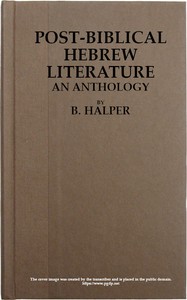
Post-Biblical Hebrew Literature: An Anthology by B. Halper
So, what exactly is this book? Post-Biblical Hebrew Literature is a collection. It's not a single story, but a curated tour through a thousand years of writing. B. Halper gathered pieces from a huge span of time—roughly from 200 BCE to 1000 CE—and from places like Spain, Italy, Egypt, and Iraq. You'll find everything here: lyrical poems about love and loss, sharp legal arguments, mystical speculations, and personal letters. It's the literary output of Jewish communities living under Roman, Persian, and later Islamic rule.
The Story
There isn't one plot. Instead, the 'story' is the intellectual and spiritual journey of a culture. The anthology opens a window into how Jewish thinkers adapted their ancient traditions to new realities. You'll read prayers composed after the destruction of the Temple, philosophical works trying to reconcile faith with Greek logic, and poetry that uses biblical language to express very human emotions. It moves chronologically, so you can see ideas develop and change over the centuries.
Why You Should Read It
I loved this because it shattered my assumption that Jewish literature was just the Bible and then nothing until the modern era. This is the vibrant, messy, and creative 'in-between' stuff. The writers feel immediate. Their struggles with doubt, their joy in ritual, their anger at injustice—it's all here. Reading a poem from 10th-century Spain about longing for Jerusalem feels powerfully current. It connects dots in history I never knew were there and gives voice to countless generations whose thoughts were preserved in Hebrew.
Final Verdict
Perfect for curious readers who love history, poetry, or religion, but want to go beyond the basics. It's for anyone who has ever wondered, "What came after the last page of the Bible?" This book is your answer. It's not a light read—you'll want to take it slow—but it's incredibly rewarding. You don't need to be a scholar; you just need an interest in the powerful ways people use words to make sense of their world.
Legal analysis indicates this work is in the public domain. Access is open to everyone around the world.
Deborah Walker
5 months agoAfter finishing this book, the character development leaves a lasting impact. Definitely a 5-star read.
Logan Martin
5 months agoI had low expectations initially, however the storytelling feels authentic and emotionally grounded. Highly recommended.
John Walker
6 months agoAs someone who reads a lot, the arguments are well-supported by credible references. One of the best books I've read this year.
Sandra Lewis
1 year agoFrom the very first page, the pacing is just right, keeping you engaged. Worth every second.


Michael Johnson
7 months agoExceptional clarity on a very complex subject.