
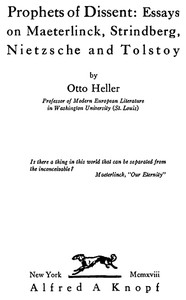
Prophets of Dissent : Essays on Maeterlinck, Strindberg, Nietzsche and Tolstoy
Otto Heller's Prophets of Dissent isn't a novel with a plot, but it has a clear mission. Written in 1918, it's a set of four long essays. Each one focuses on a giant of European thought who was shaking things up as the 19th century ended. Heller introduces us to the mystical, symbolic plays of Maurice Maeterlinck, the dark and turbulent dramas of August Strindberg, the explosive philosophy of Friedrich Nietzsche, and the moral and spiritual crusade of Leo Tolstoy. The book's 'story' is Heller's journey to understand these men. He explores their ideas, their art, and their furious arguments against the comfortable beliefs of their age. He shows how each, in their own field, was a rebel challenging religion, conventional art, and social norms.
Why You Should Read It
This book surprised me. I expected a stiff academic lecture, but Heller writes with a fire that matches his subjects. He doesn't just list their ideas; he gets you inside their heads. You feel the haunting silence in a Maeterlinck play, the raw anger in Strindberg's relationships, the thrilling danger of Nietzsche's call to go 'beyond good and evil,' and the stubborn, powerful simplicity of Tolstoy's later years. The best part is seeing them side-by-side. It makes you ask big questions: What does it mean to be a true original? Can destroying old ideas ever be a creative act? Heller shows that these 'prophets' weren't just naysayers; they were desperate to find new meaning in a world that felt increasingly empty. It's a powerful reminder that great art and thought often come from a place of deep dissatisfaction.
Final Verdict
This is a perfect pick for curious readers who want to explore big ideas but might find straight philosophy books intimidating. Heller acts as a passionate, knowledgeable guide. You'll get the most out of it if you have a passing interest in at least one of the four figures—maybe you've heard of Nietzsche's 'Übermensch' or tried to read Anna Karenina. It's also great for anyone who loves cultural history, showing how the anxieties and dreams of the past directly shaped our modern world. Fair warning: it's a book from 1918, so the language has a classic feel, but Heller's excitement is timeless. If you're ready for a challenging, brain-stretching conversation with four of history's greatest troublemakers, this is your invitation.
There are no legal restrictions on this material. Feel free to use it for personal or commercial purposes.
David Martin
1 year agoInitially, I was looking for a specific answer, but it addresses the common misconceptions in a very professional manner. Thanks for making such a high-quality version available.
Robert Jones
4 weeks agoI was skeptical about the depth of this book at first, but the insights into future trends are particularly thought-provoking. I'll be citing this in my upcoming project.
Thomas Harris
11 months agoA sophisticated analysis that fills a gap in the literature.
Matthew Wilson
1 year agoThis is an essential addition to any academic digital library.





Kimberly Rodriguez
7 months agoSolid information without the usual fluff.