
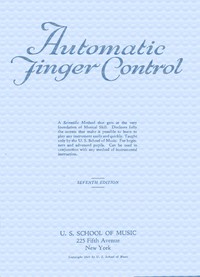
Automatic finger control by U.S. School of Music
Let's be clear from the start: this isn't a storybook. Automatic Finger Control is a technical manual, a relic from the early 20th century when the U.S. School of Music mailed out courses to aspiring musicians. It's a slim volume, all business, with one goal: to build independent, strong, and reliable fingers for the piano.
The Story
There's no plot, but there is a clear progression. The book is built on a simple, almost rigid philosophy. It argues that real technique isn't about thinking, but about conditioning. You start with the most basic five-finger positions, playing repetitive patterns with a strict focus on even tone, precise timing, and lifting each finger high. Then, you repeat. And repeat. The exercises gradually add complexity—different rhythms, accents, and eventually coordination between hands—but the core principle never wavers. Mastery comes from countless correct repetitions until the motion is wired into your muscles. The 'story' is the journey of your own hands from stiff and separate to (hopefully) fluid and automatic.
Why You Should Read It
In a world of quick-fix tutorials, this book is a fascinating reality check. There's something brutally honest about its approach. It offers zero shortcuts and makes no exciting promises. Its value lies in that purity. If you struggle with finger independence or uneven playing, doing these drills will reveal your weaknesses instantly. It's like a mirror for your technique. I found its old-fashioned, disciplined vibe weirdly motivating. It cuts out all the noise and says, 'Here is the work. Do it.' For a self-taught player used to jumping between songs, it forced me to focus on the foundational mechanics I'd always skipped.
Final Verdict
This book is not for everyone. If you need inspiration, fun pieces, or music theory, look elsewhere. It's dry as dust. But if you're a serious beginner or an intermediate player with 'wobbly' technique, and you possess the patience of a saint, this century-old manual might be a secret weapon. It's perfect for the disciplined student who wants to build a rock-solid physical foundation, the curious musician interested in historical teaching methods, or anyone who needs a strict, no-excuses regimen to whip their fingers into shape. Just don't expect it to be a fun read—expect it to be work.
This book is widely considered to be in the public domain. Feel free to use it for personal or commercial purposes.
Linda Williams
9 months agoI appreciate how this edition approaches the core problem, the concise summaries at the end of each section are a lifesaver. Truly a masterpiece of digital educational material.
Kimberly Young
1 year agoRecommended.
Anthony Sanchez
2 months agoLoved it.





Barbara White
8 months agoA must-have for graduate-level students in this discipline.