1

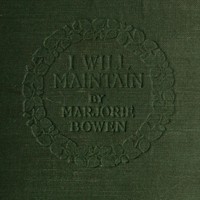
I Will Maintain — Text and Context
(0 User reviews)
656
Project Gutenberg
2016
Not confirmed
Historical fiction; Biographical fiction; Netherlands -- History -- 1648-1714 -- Fiction; William III, King of England, 1650-1702 -- Fiction; Netherlands -- Kings and rulers -- Fiction
Readers of public-domain and historical texts
Project Gutenberg digital edition
en
Edition facts
Words
157,443
Reading time
685 min
Text sections
18
The catalog record for I Will Maintain — Text and Context provides practical reading context through 157,443 words, 11 hr 25 min estimated reading time, and 18 detected text sections.
The text analysis averages about 14.4 words per sentence, while the detected sections provide another way to judge how the source is divided.
Project Gutenberg metadata also associates the work with “Historical fiction,” connecting these edition facts with the source record’s subject description.
Source:
Project Gutenberg record #53549
An editorial note on Marjorie Bowen's historical novel about William III, focusing on its structure, recurring images, and movement between scenes, based on excerpts from the Project Gutenberg edition.
Editorial Edition Score
4.8/5
★★★★★
★★★★★
Calculated from edition completeness, EPUB availability, text structure and catalogue metadata. Not a user rating.
How this score is calculated
- Description quality20 pts
- Title & short description10 pts
- Source metadata20 pts
- Text length15 pts
- Chapters / structure15 pts
- EPUB file integrity20 pts
Total of 100 points, scaled to a 2.5-5.0 range. Editions with an empty description or a missing EPUB file are not scored.
Edition quality
Public-domain source text
Read the source text
The source text is kept in the dedicated reader, separate from this catalogue record and its commentary.
Marjorie Bowen's I Will Maintain opens with a quiet garden scene in which the English ambassador Sir William Temple probes John de Witt about the Prince of Orange. The dialogue is measured, the setting domestic—wych elms and pale sunshine—yet the subject is the political future of the Netherlands. This contrast between calm interiors and violent public events recurs throughout the novel, shaping its structure. The excerpts show a work that moves between council chambers, ballrooms, and naval battles, each shift marked by a change in prose rhythm: from conversational exchanges to dense, sensory descriptions of cannon fire and wreckage.
The Architecture of Opposition
The novel is built around a series of confrontations, both verbal and physical. The opening chapter stages a polite but tense exchange between de Witt and Temple, where the Grand Pensionary's “full brown eyes” betray trouble when the Prince is mentioned. This interior conflict is mirrored later in the battle sequence, where de Ruyter's Seven Provinces engages the English flagship. Bowen uses parallel structures: the controlled dialogue of the garden gives way to the chaos of the sea, yet both scenes hinge on a question of loyalty and command. The table of contents reinforces this pattern, with chapters titled “The Ideals of M. de Witt” and “The Fallen Statesman” framing the narrative as a study of opposing forces—republican versus monarchist, civilian versus military.
Recurring Images: Light, Smoke, and Water
Bowen repeatedly employs images of light and obscurity. In the garden, “pale sunshine” filters through wych elms; in the battle, “pale fire” leaps from a burning ship, and “the curtain of smoke” conceals the fighting. Water appears as both a setting and a threat: the sea is “scattered with wreckage, and stained with trails of blood and flecks of foam.” These elements are not merely decorative—they create a sensory continuity across disparate scenes. The same “pale” quality of light in the opening returns in the description of flames, linking the political intrigue of the first part to the physical violence of the second. The motif of concealment (smoke, curtains, diplomatic evasion) suggests a world where truth is always partially hidden.
Movement Between Spaces
The excerpts reveal a deliberate geography. The narrative moves from de Witt's garden (a private, controlled space) to the Binnenhof (the political heart of The Hague), to the deck of a ship at Solebay. Each location carries its own rules and dangers. The ball in the Binnenhof, mentioned in the contents, likely serves as a transitional space where social performance masks political maneuvering. The battle scene, by contrast, strips away pretense: the Duke of York abandons his flagship, carrying his standard through “dipping bullets.” Bowen emphasizes the physical effort of movement—rowing, climbing, steering—as characters cross from one zone to another. This attention to spatial transition gives the novel a kinetic quality, even in its quieter moments.
The Weight of Historical Detail
Bowen anchors her fiction in specific historical references: the motto of the House of Orange (“Je maintiendrai”), the date August 20, 1672, and figures like Sir William Temple and Michael de Ruyter. Yet the excerpts show her using these details not as mere backdrop but as active elements in the narrative. The battle sequence includes technical language—galiots, fire-ships, 12-pounders—that conveys the mechanics of naval warfare without overwhelming the human drama. The novel's structure, with three parts and multiple short chapters, suggests a methodical approach to history, each chapter focusing on a single event or conversation. This granularity allows Bowen to explore the gap between public record and private motive, a theme hinted at in the opening dialogue.
Readers approaching I Will Maintain should attend to the way Bowen uses setting as a character in itself. The garden, the council room, and the burning ship are not interchangeable backdrops but active forces that shape the characters' choices. The novel rewards attention to recurring imagery and the rhythm of its scene changes. Whether you are interested in the politics of the Dutch Republic or the craft of historical fiction, this work offers a dense, sensory experience grounded in the tensions of the late seventeenth century.
Reading about Bowen’s careful scene-crafting reminded me of evenings spent with my grandfather, who loved histories above all. He passed me The Chainbearer; Or, The Littlepage Manuscripts — Text and Context once, and I felt the same quiet weight of land and legacy—not grand drama, just the slow pull of duty across generations. Both books feel like rooms I once wandered into and never quite left.
There are no reviews for this eBook.
There are no comments for this eBook.
Reader reflection
How will you remember this book?
Save your reaction, strongest insight, and memorable passage.
Your progress
0
/
10
2
What was your overall reaction to the book?
3
Would you pass this book on to a friend?
4
Did the language feel accessible?
5
What did you think about the pace?
6
Did it raise ideas you would like to talk about?
7
Would a second reading be valuable?
8
How distinctive were its ideas or approach?
9
What did this book teach you most?
10