1

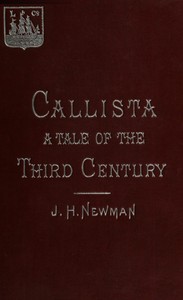
Callista : a Tale of the Third Century — Reading Notes
(0 User reviews)
177
Project Gutenberg
2009
Not confirmed
Historical fiction; Church history -- Primitive and early church, ca. 30-600 -- Fiction; Christian fiction; Tunisia -- Church history -- Fiction
Readers of public-domain and historical texts
Project Gutenberg digital edition
en
Edition facts
Words
100,767
Reading time
439 min
Text sections
14
Before opening Callista : a Tale of the Third Century — Reading Notes, the edition data offers a quick orientation: 100,767 words, 7 hr 19 min estimated reading time, and 14 detected text sections.
The text analysis averages about 20.7 words per sentence, while the detected sections provide another way to judge how the source is divided.
Project Gutenberg metadata also associates the work with “Historical fiction,” connecting these edition facts with the source record’s subject description.
Source:
Project Gutenberg record #30664
Newman's third-century novel uses precise diction and dialogue to contrast pagan and Christian worldviews, focusing on the psychological and spiritual struggles of characters in Roman Africa.
Editorial Edition Score
4.8/5
★★★★★
★★★★★
Calculated from edition completeness, EPUB availability, text structure and catalogue metadata. Not a user rating.
How this score is calculated
- Description quality20 pts
- Title & short description10 pts
- Source metadata20 pts
- Text length15 pts
- Chapters / structure15 pts
- EPUB file integrity20 pts
Total of 100 points, scaled to a 2.5-5.0 range. Editions with an empty description or a missing EPUB file are not scored.
Edition quality
Public-domain source text
Read the source text
The source text is kept in the dedicated reader, separate from this catalogue record and its commentary.
John Henry Newman's Callista opens with a poetic epigraph by De Vere that immediately establishes a central tension: the solitary nature of the soul versus the desire for human connection. The novel's diction throughout reflects this preoccupation with interior states, often rendering physical settings as extensions of spiritual conditions. Newman, writing as a Catholic convert, employs a narrator who moves between detached observation and sympathetic inwardness, particularly in scenes of persecution.
Diction of Division
Newman's word choices repeatedly emphasize separation and boundary. The mob is described as 'infuriated rabble,' their actions driven by 'malignant hatred.' In contrast, Christian characters are associated with 'privacy,' 'strictness,' and 'religious strictness.' The widow's household is 'secluded,' her children kept 'from all bad sights and bad company.' This lexical field creates a moral geography where physical space mirrors spiritual allegiance. The rioters 'gazed with envy and cupidity' at noble mansions, while Christians are 'sheltered' or 'hidden.' Even the sacristan who apostatizes is 'miserable,' a word that conveys both pity and contempt. Newman's diction thus constructs an ethical landscape where language itself becomes a marker of faith or its absence.
Dialogue as Confrontation
Dialogue in the excerpts is sparse but pointed. The mob's cry 'Bread, bread!' reduces their demand to a primal need, contrasting with the Christian widow's 'heartrending cries and supplications' for her children. When the Tertullianist seizes the idol, he acts without words—his 'sign of the cross' and the breaking of the idol over his knee are a silent sermon. Newman reserves direct speech for moments of extreme pressure, as when the sacristan is forced to worship: 'he worshipped the ass, he worshipped the idol, and he worshipped the genius of the emperor.' The repetition of 'worshipped' underscores the mechanical, coerced nature of pagan ritual. Dialogue, when it appears, is stripped of ornament, functioning as a blunt instrument of conflict.
Description as Moral Index
Newman's descriptive passages do more than set scenes; they encode moral judgments. The Christian chapel, 'long been turned to other purposes,' is now 'a store of casks and leather bottles,' its sacred function erased by commerce. The widow's 'modest apartment' is 'soon swarming with enemies,' the verb 'swarming' dehumanizing the attackers. Physical details carry theological weight: the children's ages 'between thirteen and seven' are noted precisely, emphasizing their vulnerability. The mother is 'thrown senseless upon the pavement,' the passive construction highlighting her powerlessness. Even the setting of the aristocratic quarter, with its 'closed gates' and 'high walls,' suggests a fortress under siege. Description in Callista is never neutral; it is always a vehicle for Newman's moral vision.
Structure of Escalation
The narrative structure in the excerpted passages moves from individual apostasy to collective violence. The sacristan's forced worship and death are followed by the Tertullianist's solitary defiance, then the attack on the widow's family. Each episode intensifies: first a single victim, then a pair, then a household. The mob's motives shift from 'revenge upon Christians' to 'prospect of plunder,' showing how religious fervor degenerates into greed. Newman controls pacing through short, declarative sentences: 'The poor wretch obeyed'; 'They found him, and dragged him'; 'The whole five were carried off in triumph.' The rhythm accelerates as the violence becomes more systematic. This structural escalation mirrors the novel's broader concern with the inexorable pressure of persecution on individual conscience.
Readers attentive to Newman's authorial choices will find a work where every adverb and adjective serves a theological purpose. The novel rewards close attention to its verbal texture, particularly in scenes of conflict where language itself becomes a battleground. Approach Callista not as a historical reconstruction but as a dramatized meditation on the costs of belief, rendered through a prose that is at once precise and passionate.
Reading about Newman’s Roman Africans, I remembered sitting with my grandmother, her fingers tracing a worn Bible’s spine. The rebellion of the Princess — Reading Notes felt like that same quiet, slow turning—both books hold sorrow without rushing it, letting faith and doubt breathe side by side. I finished one and simply sat, the lamp humming.
There are no reviews for this eBook.
There are no comments for this eBook.
Reader reflection
What did you think of this book?
Answer a few questions and save a private reflection on this device.
Your progress
0
/
10
2
Did this book hold your interest?
3
Would you encourage someone else to read it?
4
How demanding did the text feel?
5
Did you gain anything practical from the text?
6
Did the story or argument move comfortably?
7
Would you read this book again?
8
What was its emotional impact?
9
What did this book teach you most?
10