1

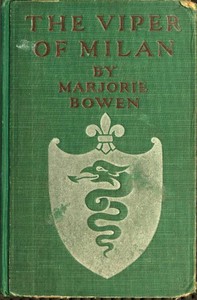
The Viper of Milan: A Romance of Lombardy — Reading Notes
(0 User reviews)
114
Project Gutenberg
2015
Not confirmed
Historical fiction; Adventure stories; Lombardy (Italy) -- History -- Fiction
Readers of public-domain and historical texts
Project Gutenberg digital edition
en
Edition facts
Words
101,049
Reading time
440 min
Text sections
11
For The Viper of Milan: A Romance of Lombardy — Reading Notes, the stored edition analysis reports 101,049 words, 7 hr 20 min estimated reading time, and 11 detected text sections.
The text analysis averages about 14.3 words per sentence, while the detected sections provide another way to judge how the source is divided.
Project Gutenberg metadata also associates the work with “Historical fiction,” connecting these edition facts with the source record’s subject description.
Source:
Project Gutenberg record #48963
Marjorie Bowen's 1906 historical romance uses swift dialogue and tense action to depict Visconti's Milan, focusing on a prison escape and a murder scene that reveal the period's Gothic vigor and Latin cruelty without elaborate description.
Editorial Edition Score
4.8/5
★★★★★
★★★★★
Calculated from edition completeness, EPUB availability, text structure and catalogue metadata. Not a user rating.
How this score is calculated
- Description quality20 pts
- Title & short description10 pts
- Source metadata20 pts
- Text length15 pts
- Chapters / structure15 pts
- EPUB file integrity20 pts
Total of 100 points, scaled to a 2.5-5.0 range. Editions with an empty description or a missing EPUB file are not scored.
Edition quality
Public-domain source text
Read the source text
The source text is kept in the dedicated reader, separate from this catalogue record and its commentary.
Marjorie Bowen's The Viper of Milan opens not with a panoramic description of Lombardy but with a publisher's preface that frames the novel's method: it gives a 'concrete, vivid and brilliant impression' of early Renaissance Italy through 'dialogue and action' rather than 'set description.' The excerpts bear this out. In one scene, Giacomo Carrara and Visconti move through a deserted castle, their lantern revealing 'dust on the floor and shadows in the arras' and a coverlet 'riddled as if with dagger-thrusts.' The narrative does not pause to paint the setting; it lets the characters' observations and the stain on the floor imply the violence that has occurred.
Action Over Atmosphere
The catalog subjects list 'Historical fiction' and 'Adventure stories,' and the excerpts confirm that Bowen prioritizes plot momentum over period detail. The escape sequence is driven by quick exchanges—'Hurry!' breathed Visconti. 'Shall we never see the blessed sky again?'—and by physical actions: snatching keys, gripping arms, stepping past. The storm is mentioned only as it affects the scene: 'The storm was over, a few great clouds tore across the sky, but the moon was clear and serene.' This is not a descriptive pause but a functional note that allows the escape to proceed. The publisher's preface explicitly states the author 'makes no attempt at an elaborate reconstruction of an epoch,' and the text follows suit. Readers expecting lush Renaissance backdrops will instead find a lean, dramatic narrative where setting emerges through character movement and dialogue.
The Viper's Voice
Visconti, the titular 'viper,' is characterized through his speech and actions rather than authorial commentary. In the escape scene, his whispered 'I do not fear them. Nor you' conveys both menace and intimacy. Later, when a German soldier approaches, Visconti smiles and says, 'I shall be obliged to—kill him.' The dash and the casual tone suggest a man for whom violence is a reflex. The excerpts do not reveal his full history, but the repeated motif of the coverlet 'riddled as if with dagger-thrusts' and the floor 'stained with blood' associates him with past murder. The catalog subject 'Lombardy (Italy) – History – Fiction' is thus rendered not through battles or treaties but through this personal, visceral threat. Bowen's Visconti is a figure of swift cruelty, his danger felt in every scene he inhabits.
Song and Silence
A striking detail in the excerpts is the German soldier Conrad's song: 'Heinrich was my bosom friend, / White feather and purple cloak: / Now that folly's at an end, / His the flame and mine the smoke!' The lyrics, with their mocking tone and refrain, interrupt the tense escape and provide a moment of dark contrast. Visconti watches from hiding, 'longing to strangle the singer with one of those long curls that hung around his laughing, careless face.' The song is not mere decoration; it highlights the carefree brutality of Conrad's world and Visconti's contained fury. The publisher's preface notes the author's 'sans-gêne' in writing of the past, and this casual violence set to a tune exemplifies that approach. The narrative does not explain the song's significance; it lets the juxtaposition of melody and murder speak for itself.
The excerpts from The Viper of Milan show a novel that earns its 'Adventure stories' classification through relentless forward motion. Bowen's method—dramatic, dialogue-heavy, and sparing with description—means that readers must attend to what characters say and do rather than to authorial summaries. The catalog subjects are accurate but incomplete: the history of Lombardy is here refracted through personal betrayal and sudden violence, not through grand political events. For those who enjoy historical fiction that moves at the speed of a thriller, this romance offers a distinctive, lean approach to the past.
Reading The Viper of Milan, I found myself pausing at that prison escape, struck by how Bowen lets cruelty speak through action alone. It reminded me of another quiet evening, another romance where the atmosphere carried everything—the heat, the tension, the unspoken. There is a similar restraint in Atmâ A Romance — Reading Notes, a gentler pulse, but the same sense of a world closing in.
There are no reviews for this eBook.
There are no comments for this eBook.
Reader reflection
What did you think of this book?
Answer a few questions and save a private reflection on this device.
Your progress
0
/
10
2
How did the book work for you overall?
3
Is this a title you would suggest to others?
4
How easy was the book to follow?
5
How clearly were the main ideas presented?
6
Did you relate to its people, ideas, or situations?
7
Which aspect of the book did you value most?
8
How valuable was this book for your own interests?
9
What changed or sharpened your thinking?
10