1

An Algonquin Maiden: A Romance of the Early Days of Upper Canada — Context and Discussion
(0 User reviews)
3390
Project Gutenberg
2005
Not confirmed
Historical fiction; Indians of North America -- Canada -- Fiction; Love stories; Algonquian Indians -- Fiction
Readers of public-domain and historical texts
Project Gutenberg digital edition
en
Edition facts
Words
77,531
Reading time
338 min
Text sections
7
The source record for An Algonquin Maiden: A Romance of the Early Days of Upper Canada — Context and Discussion measures this digital text at 77,531 words, 5 hr 38 min estimated reading time, and 7 detected text sections.
The text analysis averages about 20.5 words per sentence, while the detected sections provide another way to judge how the source is divided.
Project Gutenberg metadata also associates the work with “Historical fiction,” connecting these edition facts with the source record’s subject description.
Source:
Project Gutenberg record #8661
This editorial note examines the dual narrative voice in Adam and Wetherald's 1886 romance, focusing on shifts between lyrical landscape description and witty dialogue, and how the pace changes from meditative to brisk in scenes of social maneuvering.
Editorial Edition Score
4.7/5
★★★★★
★★★★★
Calculated from edition completeness, EPUB availability, text structure and catalogue metadata. Not a user rating.
How this score is calculated
- Description quality20 pts
- Title & short description10 pts
- Source metadata20 pts
- Text length15 pts
- Chapters / structure15 pts
- EPUB file integrity20 pts
Total of 100 points, scaled to a 2.5-5.0 range. Editions with an empty description or a missing EPUB file are not scored.
Edition quality
Public-domain source text
Read the source text
The source text is kept in the dedicated reader, separate from this catalogue record and its commentary.
The opening chapter of An Algonquin Maiden establishes a deliberate, almost painterly prose rhythm. The May morning of 1825 is described through a series of layered images—'a warm pallor in the eastern sky,' 'gray dome of nearly opaque watery fog'—that slow the reader's pace, inviting contemplation of the setting. This measured cadence, however, is not sustained uniformly. The narrative voice alternates between a detached, almost documentary tone (noting the 'five or six hundred houses' of Little York) and a more intimate, ironic register when rendering dialogue. The effect is a text that shifts gears: expansive in its landscape passages, then suddenly clipped and playful in social exchanges.
Two Voices, One Romance
The collaboration between G. Mercer Adam and A. Ethelwyn Wetherald produces a noticeable duality in narrative voice. The descriptive passages—particularly those framing the forest as 'gloomily forbidding' and 'interminable in extent'—carry a formal, almost epic weight. This contrasts sharply with the dialogue, which is brisk, ironic, and full of social gamesmanship. For instance, when Rose exclaims 'Oh, dear!' upon learning of Mr. Galton's approach, the narrator immediately undercuts the exclamation with a parenthetical: 'was the very inhospitable exclamation of its pretty mistress.' The voice here is wry, almost editorial. This split suggests either a deliberate stylistic division between the authors or a tonal strategy to juxtapose the sublime wilderness with the trivialities of colonial society. Readers may find themselves moving between two distinct sensibilities: one reverent toward the land, the other amused by its inhabitants.
Pace as a Tool of Characterization
The pacing of scenes often mirrors the emotional states of characters. In the excerpted drawing-room scene, the rhythm accelerates during the repartee between Rose, Allan, and Mr. Galton. Sentences grow shorter, interruptions multiply, and the narrator inserts quick asides ('Herbert has done me a great kindness'). This brisk tempo conveys nervous energy and romantic tension. By contrast, Allan's interior reflections—'A lover, from his very nature, must be decidedly unhappy or supremely blest'—are rendered in longer, more measured clauses, slowing the narrative to a contemplative crawl. The shift is abrupt, signaling a change from external action to internal doubt. The authors use these tempo changes to differentiate characters: Rose's dialogue is rapid and evasive, while Allan's thoughts are ponderous. The effect is a narrative that breathes with its characters, speeding up in moments of social friction and slowing when emotions deepen.
Landscape as a Counterpoint to Dialogue
The novel's opening invests heavily in setting: the forest is 'inexorable in its resistance,' the town a 'cluster' at the edge of wilderness. This language is static, almost geological in its sense of time. Yet once the narrative moves indoors, the pace quickens and the tone lightens. The contrast is stark: the landscape passages are dense with metaphor ('fortresses of the eternal forests'), while the dialogue is filled with playful barbs ('Your charities are conducted on too large a scale'). This structural alternation suggests that the authors use landscape as a foil to human triviality. The slow, solemn descriptions of Upper Canada ground the story in a specific place and era, while the rapid-fire conversations reveal the characters' preoccupations with love and status. Readers attentive to these shifts will notice how the novel's rhythm reinforces its central tension: the struggle between the enduring wilderness and the fleeting dramas of colonial life.
As you read, note how the narrative voice modulates between the lyrical and the conversational. The opening's slow, atmospheric prose gives way to sharper, quicker exchanges in domestic scenes. Pay attention to moments where the pace suddenly changes—these often signal a shift in power or emotion. The dual authorship may account for some of these variations, but they also serve a thematic purpose, mirroring the characters' navigation between the wild and the civilized.
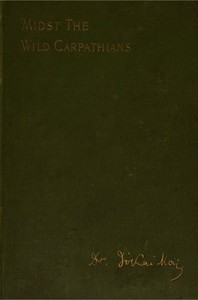
That rainy afternoon, I kept returning to the dual pace of An Algonquin Maiden—the way its quiet, lyrical stretches gave way to brisk, witty exchanges. But the stillness of the rain itself, the slow drift of hours, sent me looking for that same meditative hush elsewhere. I found it unexpectedly in 'Midst the Wild Carpathians — Inside the Classic, though its landscape was far darker, and far more foreign. The mood simply carried over.
There are no reviews for this eBook.
There are no comments for this eBook.
Reader reflection
Before you leave, reflect on the book
Use these questions to collect your thoughts before moving on.
Your progress
0
/
10
2
What was your overall reaction to the book?
3
Would you encourage someone else to read it?
4
How easy was the book to follow?
5
How strongly did the book affect you emotionally?
6
How distinctive were its ideas or approach?
7
Did you relate to its people, ideas, or situations?
8
How useful did the reading feel?
9
Which lesson or insight stayed with you?
10