1

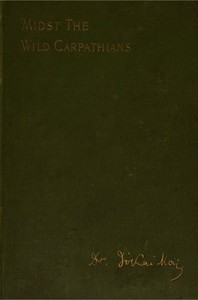
'Midst the Wild Carpathians — Inside the Classic
(0 User reviews)
2120
Project Gutenberg
2011
Not confirmed
Historical fiction; Hungarian fiction -- Translations into English; Transylvania (Romania) -- History -- Fiction
Readers of public-domain and historical texts
Project Gutenberg digital edition
en
Edition facts
Words
109,521
Reading time
477 min
Text sections
13
'Midst the Wild Carpathians — Inside the Classic can be approached with a clearer sense of reading commitment from its source measurements: 109,521 words, 7 hr 57 min estimated reading time, and 13 detected text sections.
The text analysis averages about 16.5 words per sentence, while the detected sections provide another way to judge how the source is divided.
Project Gutenberg metadata also associates the work with “Historical fiction,” connecting these edition facts with the source record’s subject description.
Source:
Project Gutenberg record #37339
This editorial note examines how Mór Jókai's historical romance, set in 17th-century Transylvania, blends supernatural folklore with political intrigue, focusing on the tension between catalog subjects and the actual narrative texture revealed in excerpts.
Editorial Edition Score
4.8/5
★★★★★
★★★★★
Calculated from edition completeness, EPUB availability, text structure and catalogue metadata. Not a user rating.
How this score is calculated
- Description quality20 pts
- Title & short description10 pts
- Source metadata20 pts
- Text length15 pts
- Chapters / structure15 pts
- EPUB file integrity20 pts
Total of 100 points, scaled to a 2.5-5.0 range. Editions with an empty description or a missing EPUB file are not scored.
Edition quality
Read the Text
Before us lies the valley of the Drave, one of those endless wildernesses where even the wild beast loses its way. Forests everywhere, maples and aspens a thousand years old, with their roots under water; magnificent morasses the surface of which is covered, not with reeds and water-lilies, but with gigantic trees, from the dependent branches of which the vivifying waters force fresh roots. Here the swan builds her nest; here too dwell the royal heron, the blind crow, the golden plover, and other man-shunning animals which are rarely if ever seen in more habitable regions.
Here and there on little mounds, left bare during the long summer drought by the receding waters, sprout strange and gorgeous flowers, such perhaps as the earth has not brought forth since the Flood overwhelmed her. In this slimy soil every blade of grass shoots up like gigantic broom; the funnel-shaped convolvuluses and the evergreen ground-ivy put forth tendrils as stout and as strong as vine branches, which, stretching from tree to tree, twine round their stems and hang flowery garlands about the dark, sombre maples, just as if some hamadryad had crowned the grove dedicated to her.
But it is only when evening descends that this realm of waters begins to show signs of life. Whole swarms of water-fowl then mount into the air, whose rueful, monotonous croaking is only broken by the melancholy piping of the bittern and the whistle of the green turtle. The swan, too, raises her voice and sings that melodious lay which now, they tell us, is only to be heard in fairy-land,--for here man has never yet trod, the place is still God's.
Now and again, indeed, sportsmen of the bolder sort presume to penetrate far into this pathless labyrinth of bush and brake; but they are forced to wind their way among the trees in canoes which may at any moment be upset by the twisted tangle of roots stretching far and wide beneath the water, and it is just in these very places that the swamp is many fathoms deep; for although the dark green lake-grass and the yellow marsh-flowers, with the little black-and-red efts and newts darting about among them, seem close enough to be reached by an outstretched hand, they are nevertheless all under water deep enough to go over the head of the tallest man.
In other places it is the dense thicket which bars the canoe's way. Fallen trees, the spoil of many centuries, but untouched by the hand of man, lie rotting there in gigantic heaps. The submerged trunks have been turned to stone by the water, and the roots of the lake-grass, the filaments of the flax-plant, and the tendrils of the clematis have grown together over them, forming a strong, tough barrier just above the water which rocks and sways without giving way beneath one's feet. The knotty clout-like film of the lake, stretching far and wide, seems, to the careless eye, a continuation of this barrier, but the treacherous surface no longer bears--one step further, and Death is there. This unknown, unexplored region has however but few visitors.
Southwards, the wilderness is bounded by the river Drave. The trees which line its steep banks dip over into its waves. Not unfrequently the fierce stream sweeps them into its bed and away, to the great peril of all who sail or row upon its waters.
Northwards, the forest extends as far as Csakatorny, and where the morass ends oaks and beeches of all sorts flourish. In no other part of Hungary will you meet with trees so erect and so lofty. The wide waste abounds with all sorts of game. The wild boars, which wallow in the swampy ground there, are the largest and fiercest of their kind. The red deer too is no stranger there, and huge, powerful, and courageous you will find him; nay, at that time, even gigantic elks showed themselves occasionally, and made nocturnal incursions into the neighbouring millet-fields of Totovecz; but at the first attempt to lay hands upon them, they would throw themselves into the innermost swamps, whither it was impossible to follow them....
On one of the brightest days of the year in which our story begins, a numerous hunting-party was bustling about an old-fashioned hunting-box which then stood on the borders of the forest.
Mór Jókai's 'Midst the Wild Carpathians opens with a scene that immediately signals its hybrid nature: a patrol officer interrogates a Wallachian peasant about a panther, only to be met with references to the 'Gradina Dracului' (Devil's Garden). The peasant, Sange Moarte, is described as 'motionless as the corpse itself,' his responses punctuated by feverish starts and whispered confessions. This moment, drawn from the excerpts, reveals a narrative that intertwines official duty with supernatural dread, a blend that the catalog subjects—'Historical fiction,' 'Transylvania (Romania) — History — Fiction'—only partially capture.
Folklore as Narrative Engine
The excerpts show that Jókai does not merely set his story in a superstitious milieu; he uses folk belief to drive plot and characterization. When the patrol officer, Clement, presses Sange Moarte about the panther, the local priest and magistrate react with ritualized fear: they 'crossed themselves thrice' and the magistrate 'gazed devoutly on a mural St. Peter.' The priest warns that 'of all who have visited the Devil's Garden, not one has ever been known to come back.' This is not background color but a structural element—Clement's decision to go there, despite his own Unitarian skepticism, creates a narrative trajectory. The catalog subject 'Historical fiction' might suggest a focus on political events, but the excerpts foreground a world where the supernatural is treated as a tangible threat, shaping characters' actions and the story's direction.
Character Through Dialogue and Gesture
Jókai builds character through specific, often humorous, exchanges. Clement the Clerk is introduced as a pragmatic official: 'I don't go there for the pleasure of the thing,' he says of the Devil's Garden, 'but because I object to scaling mountains. In my official capacity, however, I have no choice.' His dry wit contrasts with the priest's earnest piety and the Turk Zülfikar's literal-minded distrust. When Clement asks for sandals instead of amulets, and later struggles to draw his sword—a sword that 'requires two men to draw it'—the physical comedy underscores his earthiness. The Turk's response, 'If you spring, I will spring too,' reveals a character bound by orders yet capable of sardonic loyalty. These details, traceable to the excerpts, show Jókai's method: he defines figures not through exposition but through their reactions to the bizarre and the bureaucratic.
Translation and Cultural Mediation
The excerpts include translator R. Nisbet Bain's introduction, which frames the novel as 'the best of Jokai's great historical romances' and praises its 'powers of description, especially of nature, his dramatic intensity, and his peculiar humour.' Bain's language—'bizarre, gorgeous, and picturesque forms flit before us'—reveals his own interpretive lens, one that emphasizes exoticism. Yet the excerpts themselves show a more textured reality: the Wallachian peasant's terror, the priest's crossing himself, the clerk's casual heresy. The catalog subjects list 'Hungarian fiction — Translations into English' and 'Transylvania (Romania) — History — Fiction,' but the translation choices—such as retaining 'Gradina Dracului' with a footnote—highlight the cultural gaps the text must navigate. Readers encounter a world where Romanian folklore, Hungarian politics, and Ottoman influence coexist, mediated through Bain's late-Victorian English.
Readers approaching 'Midst the Wild Carpathians should attend to how Jókai balances the historical and the folkloric. The excerpts suggest that the novel's political conspiracies—the rise of Michael Apafi, the death of Denis Banfi—are interwoven with scenes of supernatural encounter and bureaucratic farce. Pay particular attention to the minor characters: the priest, the Turk, the Wallachian peasant. Their voices, often comic or fearful, provide a counterpoint to the grand historical drama, revealing the everyday textures of a borderland where the devil is as real as the pasha.
There’s a peculiar ache in reading Jókai’s Carpathians—how the folklore shadows the politics, so you’re never quite sure which is more real. I found that same strange haze in The Princess Dehra — Themes and Context, where the past feels equally close and unreachable. Sometimes a book stays with you less for its story than for that quiet, unresolved mood it leaves behind.
There are no reviews for this eBook.
There are no comments for this eBook.
Reader reflection
Your personal reading reflection
Build a private reading journal entry for this title.
Your progress
0
/
10
2
What was your overall reaction to the book?
3
How likely are you to recommend this book?
4
What was the reading difficulty like?
5
What was its emotional impact?
6
Did the story or argument move comfortably?
7
Would you like to discuss this book with someone?
8
Did the book meet your expectations?
9
What is the main idea you are taking away?
10