
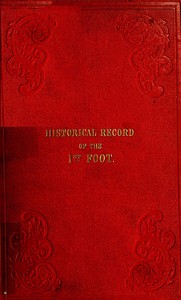
Historical Record of the First, or Royal Regiment of Foot by Richard Cannon
Let's be clear from the start: Richard Cannon's Historical Record of the First, or Royal Regiment of Foot is not a novel. Don't come looking for a sweeping narrative or character arcs. Published in 1847, this book is a formal, regimental history commissioned by the British War Office. Cannon, a military clerk, compiled it from the official archives.
The Story
There's no plot in the traditional sense. The book is a chronological record. It starts with the regiment's raising in the 1600s and marches, year by year, through two centuries of European warfare. It lists the battles—the Boyne, Blenheim, Culloden, the American Revolution, the Napoleonic Wars. For each engagement, you get the basic facts: where it was, who commanded, and the brutal, unadorned casualty figures. Interspersed are details on changes in uniform, colonels-in-chief, and where the regiment was stationed. The 'story' is the relentless accumulation of these facts, painting a picture of an institution that endured through constant violence.
Why You Should Read It
The power of this book is in its stark, administrative tone. There's no glory, just record-keeping. When you read a line like 'Loss: 1 sergeant, 12 rank and file killed; 2 sergeants, 27 rank and file wounded,' the abstraction of war falls away. It forces you to imagine the individual men behind those numbers. It’s also a fascinating look at how the 19th-century military viewed its own history—as a lineage of service and sacrifice, meant to inspire the soldiers of Queen Victoria's era. You're not reading a historian's analysis; you're reading the raw material they would later use.
Final Verdict
This is a niche read, but a rewarding one. It's perfect for military history enthusiasts who want to go beyond popular summaries and see the primary framework of a regiment's life. It's also great for writers or researchers looking for authentic period detail on the British Army. If you need a gripping story, look elsewhere. But if you're fascinated by the gritty, factual skeleton of history, this is a compelling and oddly sobering document. Think of it as the ultimate, official biography of a fighting unit.
This title is part of the public domain archive. Distribute this work to help spread literacy.
Susan Garcia
1 year agoClear, concise, and incredibly informative.
Richard Gonzalez
8 months agoAfter a thorough walkthrough of the table of contents, the nuanced approach to the central theme was better than I expected. A trustworthy resource that I'll keep in my digital library.
Paul Wright
1 year agoI came across this while browsing and the clarity of the writing makes this accessible. One of the best books I've read this year.
Amanda Jackson
1 year agoNot bad at all.







Matthew Martin
9 months agoAfter a thorough walkthrough of the table of contents, the logic behind each conclusion is easy to follow and verify. Simple, effective, and authoritative – what else could you ask for?