Is It Correct to Say ‘Reply Me’?
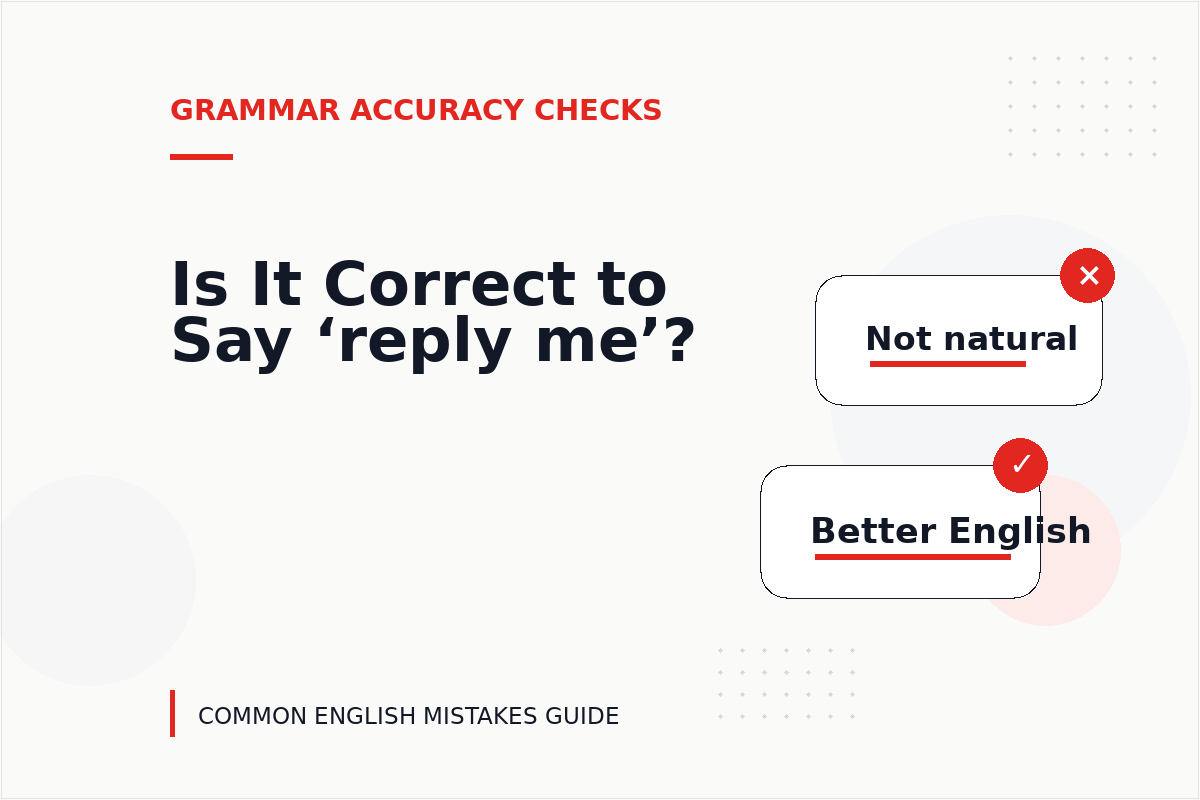
No, it is not correct to say “reply me” in standard English. The verb “reply” is intransitive, meaning it cannot take a direct object. You must use the preposition “to” before the person you are replying to. The correct phrase is “reply to me.” This is a very common mistake for learners whose first language allows a direct object after “reply,” such as in Indian English, many European languages, or Asian languages. Saying “reply me” will be understood, but it sounds ungrammatical and unnatural to native speakers.
Quick Answer
Incorrect: Please reply me soon.
Correct: Please reply to me soon.
Use “reply to” when you mention the person. You can also use “reply” alone without an object: “Please reply soon.”
Why ‘Reply Me’ Is a Mistake
The verb “reply” belongs to a group of verbs that require a preposition before an indirect object. Compare it with similar verbs:
| Verb | Correct Pattern | Incorrect Pattern |
|---|---|---|
| reply | reply to someone | reply someone |
| respond | respond to someone | respond someone |
| listen | listen to someone | listen someone |
| talk | talk to someone | talk someone |
| write | write to someone | write someone (US English accepts this in informal contexts) |
| answer | answer someone | answer to someone (except in specific contexts) |
Notice that “answer” is different. You can say “answer me” because “answer” is transitive. This difference often confuses learners. Always check whether a verb needs a preposition.
Formal vs. Informal Tone
The rule applies in both formal and informal English. In a casual text message, you might hear someone say “Reply me back,” but this is still non-standard. Native speakers may use it in very relaxed speech, but it is not considered correct in writing or careful speech.
- Formal email: “Kindly reply to me at your earliest convenience.”
- Informal message: “Hey, reply to me when you get this.”
- Incorrect informal: “Hey, reply me when you get this.”
In email contexts, you often do not need to say “to me” at all. The context makes it clear. For example: “Please reply by Friday.” This is natural and correct.
Natural Examples
Here are sentences that sound natural to native speakers:
- Could you reply to me before the meeting?
- She never replied to my message.
- I replied to him yesterday.
- Please reply to this email with your confirmation.
- He didn’t reply to any of my questions.
- We are waiting for you to reply to our offer.
Common Mistakes
Here are the most frequent errors learners make with “reply”:
- Mistake: Reply me back.
Correction: Reply to me. (Adding “back” is redundant but common; still use “to.”) - Mistake: I will reply you later.
Correction: I will reply to you later. - Mistake: She replied me the answer.
Correction: She replied to me with the answer. OR She gave me the answer. - Mistake: Please reply my email.
Correction: Please reply to my email.
Better Alternatives
Sometimes “reply to” can sound a little stiff. Here are natural alternatives depending on the situation:
- In conversation: “Get back to me” – “Can you get back to me by tomorrow?”
- In email: “Respond to” – “Please respond to my request.”
- In casual chat: “Answer me” – “Just answer me, please.”
- In formal writing: “Provide a response” – “Kindly provide a response to the inquiry.”
When to Use ‘Reply’ Without ‘To’
You can use “reply” without “to” when you do not mention the person or thing being replied to. Examples:
- I sent a message, but she didn’t reply.
- Please reply as soon as possible.
- He replied with a smile.
- She replied that she was busy.
In these cases, “reply” is used intransitively, and no preposition is needed.
Mini Practice Section
Test yourself. Choose the correct option for each sentence.
1. Please _______ when you receive this email.
a) reply me
b) reply to me
c) reply
Answer: c) reply (or b) reply to me – both are correct depending on context. Here, “reply” alone is most natural.)
2. She never _______ my question.
a) replied
b) replied to
c) replied me
Answer: b) replied to
3. I will _______ you later tonight.
a) reply
b) reply to
c) reply me
Answer: b) reply to
4. He didn’t _______ my invitation.
a) reply
b) reply to
c) reply me
Answer: b) reply to
FAQ
1. Is “reply me” ever correct in any dialect?
In some regional varieties of English, such as Indian English, “reply me” is commonly used and may be considered acceptable in informal local contexts. However, it is not standard in international English, and it is best to use “reply to me” in professional or academic writing.
2. Can I say “reply me back”?
No. “Reply me back” is a double error. Use “reply to me” or simply “reply.” If you want to emphasize a return message, say “reply back to me,” but this is still informal. “Get back to me” is a better informal alternative.
3. What about “answer me”? Is that correct?
Yes. “Answer” is a transitive verb, so “answer me” is correct. Example: “Please answer me.” This is one reason learners confuse “reply” and “answer.”
4. How do I remember to use “reply to”?
Think of “reply” as similar to “talk” or “listen.” You talk to someone, you listen to someone, and you reply to someone. If you can replace “reply” with “respond,” use “to” because “respond” also requires “to.”
Final Tip
Whenever you write “reply me,” stop and add “to.” It is a small change that makes a big difference in your English accuracy. For more help with common grammar issues, explore our Grammar Accuracy Checks section. If you have questions about this guide, visit our FAQ page or contact us. We also recommend reviewing our Editorial Policy to understand how we create these resources.