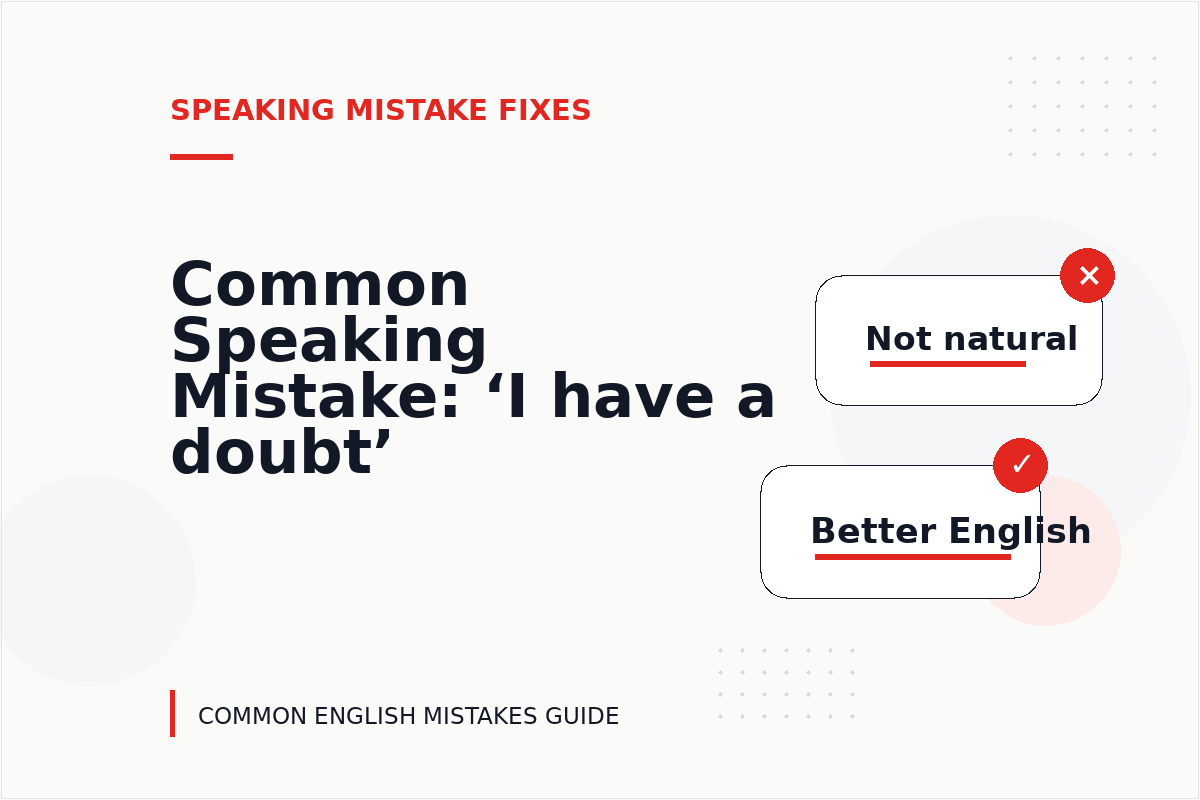
Common Speaking Mistake: ‘I have a doubt’ Explained
If you have ever said “I have a doubt” in an English conversation, you may have noticed a confused look from your listener. This phrase is a direct translation from many languages, including Spanish, French, Portuguese, and Indian languages, but it is not used in standard English. The correct way to express uncertainty or a question is to say “I have a question,” “I am not sure,” or “I have a concern.” This guide explains exactly why “I have a doubt” is a mistake, when it might be understood, and what to say instead in real conversations, emails, and study situations.
Quick Answer: What to Say Instead of “I Have a Doubt”
In standard English, “doubt” means you believe something is unlikely or false. It is a strong word. If you simply want to ask for clarification or express uncertainty, use these phrases:
- I have a question. (Use when you want to ask something)
- I am not sure. (Use when you are uncertain)
- I have a concern. (Use when you are worried about a specific issue)
- Could you clarify that? (Use in formal or classroom settings)
- I am confused about… (Use when you do not understand)
Why “I Have a Doubt” Is a Mistake
The word “doubt” in English carries a specific meaning: a feeling of uncertainty or lack of conviction about something. It is not a synonym for “question.” When you say “I have a doubt,” a native speaker hears “I believe this is probably wrong” or “I am skeptical.” This is much stronger than what you likely mean, which is simply “I do not fully understand” or “I want more information.”
This mistake is very common among learners whose first language uses a word similar to “doubt” to mean “question.” For example, in Spanish, “tengo una duda” is perfectly natural for “I have a question.” But in English, the direct translation does not work the same way.
Comparison Table: “Doubt” vs. “Question” vs. “Concern”
| Phrase | Meaning | When to Use | Example |
|---|---|---|---|
| I have a doubt | I think this is probably wrong | Rarely used in conversation; sounds unnatural | “I have a doubt about his honesty.” (strong skepticism) |
| I have a question | I want to ask for information | Everyday conversation, class, meetings | “I have a question about the homework.” |
| I am not sure | I am uncertain | Expressing personal uncertainty | “I am not sure if this is correct.” |
| I have a concern | I am worried about a specific issue | Formal or professional settings | “I have a concern about the deadline.” |
| Could you clarify | Please explain more clearly | Formal, polite requests | “Could you clarify the third point?” |
Natural Examples
Here are real-life examples showing how to express uncertainty or ask for clarification correctly.
In a Classroom
- Incorrect: “Teacher, I have a doubt about the grammar rule.”
- Correct: “Teacher, I have a question about the grammar rule.”
- Correct: “Could you explain the grammar rule again? I am not sure I understood.”
In a Business Meeting
- Incorrect: “I have a doubt about the budget numbers.”
- Correct: “I have a question about the budget numbers.”
- Correct: “I have a concern about the budget numbers. They seem higher than expected.”
In Everyday Conversation
- Incorrect: “I have a doubt about where we are meeting.”
- Correct: “I am not sure where we are meeting. Can you confirm?”
- Correct: “I have a question about the meeting location.”
In an Email
- Incorrect: “I have a doubt regarding the invoice.”
- Correct: “I have a question regarding the invoice.”
- Correct: “Could you clarify the invoice details?”
Common Mistakes
Here are the most frequent errors learners make with “doubt” and how to fix them.
Mistake 1: Using “Doubt” for Simple Questions
Wrong: “I have a doubt. Can you help me?”
Right: “I have a question. Can you help me?”
Mistake 2: Using “Doubt” in Class
Wrong: “Sir, I have a doubt about the second exercise.”
Right: “Sir, I have a question about the second exercise.”
Mistake 3: Using “Doubt” When You Mean “Uncertainty”
Wrong: “I have a doubt if I should go.”
Right: “I am not sure if I should go.”
Mistake 4: Using “Doubt” in Professional Emails
Wrong: “I have a doubt about the project timeline.”
Right: “I have a question about the project timeline.” or “I would like clarification on the project timeline.”
Better Alternatives: When to Use Each Phrase
Choosing the right phrase depends on the situation and your exact meaning. Here is a quick guide.
“I have a question” – Most Common and Safe
Use this in almost any situation where you want to ask for information. It is neutral, polite, and works in formal and informal settings.
Example: “I have a question about the schedule.”
“I am not sure” – For Personal Uncertainty
Use this when you are expressing your own lack of knowledge or confidence. It is not a request for information, but a statement about yourself.
Example: “I am not sure if I can finish this today.”
“I have a concern” – For Worries or Problems
Use this when you are worried about something specific. It is more formal and often used in professional or serious contexts.
Example: “I have a concern about the safety of this equipment.”
“Could you clarify” – Polite and Formal
Use this in formal writing, meetings, or when you need a detailed explanation. It is very polite.
Example: “Could you clarify what you mean by ‘flexible hours’?”
“I am confused about” – Honest and Direct
Use this when you genuinely do not understand. It is acceptable in casual and some professional settings, but avoid it in very formal emails.
Example: “I am confused about the instructions for step three.”
Mini Practice Section
Test your understanding with these four questions. Choose the best option for each situation.
Question 1
You are in a class and the teacher just explained a new concept. You want to ask for more details. What do you say?
A) “I have a doubt about this.”
B) “I have a question about this.”
C) “I doubt this is correct.”
Answer: B) “I have a question about this.”
Question 2
You are in a meeting and you are worried that the project deadline is too tight. What do you say?
A) “I have a doubt about the deadline.”
B) “I have a concern about the deadline.”
C) “I have a question about the deadline.”
Answer: B) “I have a concern about the deadline.” (This expresses worry, not just a request for information.)
Question 3
You are not sure if you understood the directions correctly. What do you say?
A) “I have a doubt if I understood.”
B) “I am not sure I understood.”
C) “I doubt I understood.”
Answer: B) “I am not sure I understood.”
Question 4
You are writing a polite email to a colleague asking for more information about a report. What do you write?
A) “I have a doubt about the report.”
B) “I have a question about the report.”
C) “I doubt the report is correct.”
Answer: B) “I have a question about the report.”
FAQ: Common Questions About “I Have a Doubt”
1. Is “I have a doubt” ever correct in English?
Yes, but only in very specific situations where you mean “I am skeptical” or “I believe this is probably wrong.” For example: “I have a doubt about his story because it changed three times.” However, this usage is rare in everyday conversation. Most of the time, learners use it incorrectly to mean “I have a question.”
2. Why do so many learners say “I have a doubt”?
This is a direct translation from many languages. In Spanish, French, Portuguese, Hindi, and others, the word for “doubt” is also used to mean “question” in educational contexts. Learners naturally transfer this pattern to English, but it does not match native usage.
3. Can I use “doubt” as a verb?
Yes, “doubt” as a verb is common and correct. For example: “I doubt he will come” means “I think it is unlikely he will come.” This is different from the noun form used in “I have a doubt.” The verb form is natural and widely used.
4. What should I say in a formal email instead of “I have a doubt”?
In formal emails, use phrases like “I have a question regarding,” “I would like clarification on,” or “I am writing to ask about.” For example: “I have a question regarding the payment terms” or “Could you please clarify the delivery schedule?” These are professional and clear.
Final Note
Correcting this small mistake will make your English sound much more natural. Remember: “doubt” is for skepticism, “question” is for asking, “concern” is for worry, and “not sure” is for personal uncertainty. Practice using these alternatives in your daily conversations and writing. If you want to learn more about common speaking errors, visit our Speaking Mistake Fixes section. For help with grammar, check our Grammar Accuracy Checks. If you have feedback or suggestions, please contact us. You can also read our Editorial Policy to understand how we create these guides.